Wednesday, 28 September 2011

Internet and its Uses in Our Daily Life

Internet and its Uses in Our Daily Life


The impact of the Internet on our life is obvious and cannot be sidelined. It has use in almost each and every domain of business. The popular uses of the Internet have been discussed in detail in the following article.
How difficult our life would have been if there was no Internet. Think about it. To find some information, we all have acquired the habit of 'Googling' it on the web; within a few seconds the screen displays the desired information. You want to book tickets for a movie night with friends, you can book them at the click of a button, again through the Internet media. Many of us cannot imagine life without the social networking sites. The Internet has indeed made the world a small place and living life easier. And the rapid progress of technology has made it possible to access the Internet from anywhere through plenty of means. It has such a plethora of uses in our daily life that we use it for one purpose or the other almost daily. The routine uses and some positive effects of the Internet in various sectors have been discussed in detail below.

The Uses of the Internet in Daily Life

For Information:
For a layman, Internet is nothing but a collection of websites. And there are innumerable websites that serve a variety of purposes. There are news websites, social networking websites, websites that provide information and websites of various businesses and organizations. These websites are updated frequently to provide information to the user. You can find everything of anything on the web just by browsing through a few websites. You can also use emails, blogs, IM chat, social networking websites and communication software for sharing your information with the world. The Internet has made access to information cheaper and easier and this is its most common use in daily life.

Business & Advertising:
Almost all the businesses these days have websites, through which they promote and advertise themselves. This medium these days has been used extensively for promotional campaigns. Not only promoting your business but you can also effectively advertise your event or any cause on this medium. There are many businesses that depend on the Internet for their survival like stocks and call centers, to name a few. It has promoted faster access to necessary information which strengthens the business processes.

Education:
Internet also is a popular medium used by students. Many students use it for educational purposes, like for finding study material or for applying to some college or university. It is now a virtual world and all the applications are done online through the website of the concerned educational body. Students use websites for these and many other purposes like checking exam results, exam schedule, application procedure to any course, etc. Students also take the help of the Internet for project help and for obtaining the required images. Everything on the Internet is a click away from us.

Communication & Networking:
The use of the Internet for networking is very popular among all age groups. There are many good social networking websites that are used by people for communication. These websites provide an effective and easy platform that facilitates interaction. In daily life, it is widely used as a means of communication through means like networking websites, chat websites, blogs, etc. Through these websites you can also share your photographs with your near and dear ones. The Internet is widely used by job seekers for job applications and job searching. Facilities like video conferencing has made it possible to conduct interviews online.

Entertainment:
Another popular use of the Internet in daily life is for entertainment. Facilities like listening to online music, downloading music and movies provides a platform for entertainment. There are plenty of other ways through which you can entertain yourselves on the Internet. You can play online games, view sports matches, or watch videos of your choice. It is a trusted means of entertainment for these kinds of purposes and is extensively used for the same.

Other Popular Uses:
It is popularly used for banking. Almost all the banking transactions are possible through this medium. Apart from these common uses, it can also be used for shopping. Online shopping is very popular among masses and on the Internet you can buy any thing and get it delivered at home. There are also many people who use it to work from home.

These were some of the chief common uses of the Internet in our daily life. It is a boon for us and has made our life easy by facilitating so many uses. But it is also prone to attacks of many kinds that threaten safety over the Internet. To protect the Internet from these attacks we should all use it carefully and also protect ourselves from various privacy intrusions. The Internet as a tool for communication will always remain its most powerful use. The array of uses of the Internet is vast and with the progress of technology new uses will get added to the list of uses continuously.


latest vacancy/jobs click here

www.orbittutorials.com provide jobs from all newspapers in pakistan like: All Paper Jobs, Paper PK Jobs, Jang newspaper jobs, Dawan newspaper jobs, express newspaper jobs and nawaiwaqt newspaper jobs. The basic reason of this site is to provide daily published jobs from all newspaper at one place to all job seekers. 


Monday, 26 September 2011

Gold forecast to beat $2,000 in the next year 2012-2015


Gold forecast to beat $2,000 in the next year

The gold market is revving up to reach new record highs in excess of $2,000 an ounce in the next year, according to the average forecast of bankers, traders and investors at the gold industry’s largest annual gathering.

The bullish prediction, if correct, suggests that the gold bull market remains intact, despite the price of the metal having already gained almost 30 per cent this year and 600 per cent over the past decade.

Central banks return as gold buyers

The widespread optimism at the London Bullion Market Association conference in Montreal, the largest gathering of the gold industry, comes as the gold market has been transformed from a backwater dominated by jewellery demand to one of the hottest investment assets.

The conference, which enjoyed a record attendence in excess of 500, predicted that gold would be trading at $2,019 a troy ounce at the time of next year’s meeting in November 2012. That would mark a fresh nominal record for gold, although it is still below the inflation-adjusted peak touched in 1980, which translates to more than $2,400 in today’s money.

The delegates at the LBMA conference have a strong record of predicting the trajectory of the gold price, although their forecasts have traditionally been overcautious. Last year, with gold trading at $1,298 an ounce, the conference predicted a price of $1,450. On Tuesday, bullion was trading at $1,805.70, down from a record peak of $1,920 in early September.

The forecasts, if accurate, bode well for hedge fund managers such as John Paulson of Paulson & Co and David Einhorn of Greenlight Capital, who bought gold in the financial crisis as a means of betting that governments and central banks would fail to safeguard their economies from the market turmoil.

Many hedge fund investors believe a sharp appreciation in the gold price is likely as they expect the eurozone debt crisis to deepen.

Despite the optimistic price predictions, traders were wary of growing volatility in the gold market, which has experienced some of the sharpest swings on record in recent weeks. Asked whether the market was in a bubble, 39 per cent of the traditionally bullish audience replied that it was. A growing number expect the market to accelerate in the next year or two and peak above $2,500.

“We expect to see $2,500 some time in the next 12 months,” said Som Seif, chief executive of Claymore Investments, a Canadian asset manager.

The most bullish forecast came from Pierre Lassonde, chairman of Franco-Nevada, who predicted that gold would reach parity with the Dow Jones Industrial Average index, at present trading at 11,400, within the next four to six years. “This bull market is far from over,” said Mr Lassonde, whose predictions are optimistic even by the standards of market bulls.

A drop below $1,600 an ounce could mark the end of the rally for the next few months, traders believe – although many expect demand from Asian investors and central banks to prop up prices above that level.

Mr Lassonde said: “I think there’s going to be a strong correction at some point and it’s going to set up the last phase that will take the market to numbers that few people can imagine.”

The bullish sentiment has been underpinned by the strength of demand for coins and small bars from retail investors from Germany to China.

Steven Nathan, marketing director at the Rand Refinery in South Africa, said that sales of the popular gold krugerrand coin were at a record level: “Demand is insatiable. It’s the strongest period ever right now.”

A comparable surge in demand was reported by other mints, refiners and coin dealers. “I just can’t see the price coming down,” said one senior precious metals banker. “Physical demand is incredibly strong.”

It may be tempting to push the analysis even further and question if gold is a safe haven from market volatility and fears, or it’s just a popular buy among Chinese and Indians worried about inflation. 

The reasoning for this is that gold’s rally this year has been driven primarily by retail investors in China and India, as well as central bank buying. 

And it may well be Chinese and Indian consumers are enough to rescue gold from falling off the same cliff that oil did after the 2008 crude bubble popped in spectacular fashion in the last global financial crisis. 

Of course, there has been more to gold’s rally in 2011 than Asian buyers with some additional demand from so-called sophisticated investors in the form of paper gold futures and exchange-traded funds, but this pales when compared to the buying in the form of jewellery and bars and coins.
Gold surged 35 percent from the start of the year to the Sept 6 peak, before slumping as the dollar gained when investors sought the ultimate safety of US Treasuries amid fears of a new global recession. 

Gold has dropped some 14 percent so far this September, its worst monthly performance in almost three years. Of course, part of this is just the recent strength of the US dollar. In euro terms, gold is down about 1.6 percent since its recent peak on Sept.9 and in Australian dollar terms it’s down 6 percent since the recent peak on Aug 22. 

Bullish gold bets on COMEX were cut by almost 14 percent to 160,322 contracts last week as hedge funds and other speculators rushed for the exits, their haste being aided by an increase in the margin requirements to hold gold lots. 
The ETFs fared better, with the largest, the SPDR Gold Trust, remaining relatively stable with 1,252 tonnes of the yellow metal at the end of last week. 

This is down from the Aug. 8 peak of 1,309 tonnes and from the 1,280 that the fund started the year holding. 
The COMEX Gold Trust, which has been taking market share from the SPDR, ended last week with about 168 tonnes of gold, up from 117 tonnes at the start of the year. 

Wednesday, 21 September 2011

WHAT IS Wireless Fidelity Wi-Fi


Wireless Fidelity Wi-Fi


A typical Wi-Fi setup contains one or more Access Points (APs) and one or more clients. An AP broadcasts its SSID (Service Set Identifier, "Network name") via packets that are called beacons, which are usually broadcast every 100 ms. The beacons are transmitted at 1 Mbit/s, and are of relatively short duration and therefore do not have a significant effect on performance. Since 1 Mbit/s is the lowest rate of Wi-Fi it assures that the client who receives the beacon can communicate at least 1 Mbit/s. Based on the settings (e.g. the SSID), the client may decide whether to connect to an AP. If two APs of the same SSID are in range of the client, the client firmware might use signal strength to decide which of the two APs to make a connection to.

The Wi-Fi standard leaves connection criteria and roaming totally open to the client. This is a strength of Wi-Fi, but also means that one wireless adapter may perform substantially better than the other. Since Wi-Fi transmits in the air, it has the same properties as a non-switched ethernet network.
 

Wi-Fi Devices

Wireless Access Point (WAP)

A wireless access point (AP) connects a group of wireless stations to an adjacent wired local area network (LAN). An access point is similar to an ethernet hub or switch, but instead of relaying LAN data only to other LAN stations, an access point can relay wireless data to all other compatible wireless devices as well as to a single (usually) connected LAN device, in most cases an ethernet hub or switch, allowing wireless devices to communicate with any other device on the LAN.
 

Wireless Routers

A wireless router integrates a wireless access point with an IP router and an ethernet switch . The integrated switch connects the integrated access point and the integrated ethernet router internally, and allows for external wired ethernet LAN devices to be connected as well as a (usually) single WAN device such as cable modem or DSL modem . A wireless router advantageously allows all three devices (mainly the access point and router) to be configured through one central configuration utility, usually through an integrated web server .

Wireless Ethernet Bridge

A wireless Ethernet bridge connects a wired network to a wireless network. This is different from an access point in the sense that an access point connects wireless devices to a wired network at the data-link layer . Two wireless bridges may be used to connect two wired networks over a wireless link, useful in situations where a wired connection may be unavailable, such as between two separate homes.
 

Advantages of Wi-Fi

  • Allows LANs to be deployed without cabling, typically reducing the costs of network deployment and expansion. Spaces where cables cannot be run, such as outdoor areas and historical buildings, can host wireless LANs.
  • Wi-Fi silicon pricing continues to come down, making Wi-Fi a very economical networking option and driving inclusion of Wi-Fi in an ever-widening array of devices.
  • Wi-Fi products are widely available in the market. Different brands of access points and client network interfaces are interoperable at a basic level of service. Products designated as Wi-Fi CERTIFIED by the Wi-Fi Alliance are interoperable and include WPA2 security.
  • Wi-Fi networks support roaming, in which a mobile client station such as a laptop computer can move from one access point to another as the user moves around a building or area.
  • Wi-Fi networks support roaming, in which a mobile client station such as a laptop computer can move from one access point to another as the user moves around a building or area.
  • Wi-Fi is a global set of standards. Unlike cellular carriers, the same Wi-Fi client works in different countries around the world.
 

Disadvantages of Wi-Fi

  • Wi-Fi can be interrupted by other devices, notably 2.4 GHz cordless phones and microwave ovens.
  • Power consumption is fairly high compared to some other standards, making battery life and heat a concern.
  • The most common wireless encryption standard, Wired Equivalent Privacy or WEP, has been shown to be breakable even when correctly configured.
  • Wi-Fi Access Points typically default to an open ( encryption -free) mode. Novice users benefit from a zero configuration device that works out of the box but might not intend to provide open wireless access to their LAN.
  • Wi-Fi networks have limited range. A typical Wi-Fi home router using 802.11b or 802.11g with a stock antenna might have a range of 45 m (150 ft) indoors and 90 m (300 ft) outdoors. Range also varies with frequency band, as Wi-Fi is no exception to the physics of radio wave propagation. Wi-Fi in the 2.4 GHz frequency block has better range than Wi-Fi in the 5 GHz frequency block, and less range than the oldest Wi-Fi (and pre-Wi-Fi) 900 MHz block. Outdoor range with improved antennas can be several kilometres or more with line-of-sight.
  • Wi-Fi networks can be monitored and used to read and copy data (including personal information) transmitted over the network when no encryption such as VPN is used. 

HOW TO BLOCKED PORN SITES WITHOUT ANY SOFTWARE

How to block websites

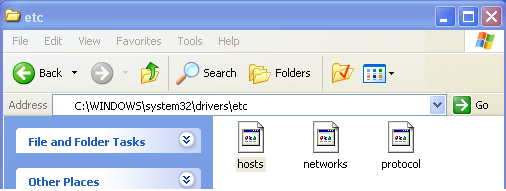
Well many of you wants you wants to block any webiste from your computer either for children saftey or for blocking any software from getting black-listed, then here are simple and few steps to do it:Before continuing let me tell how it works, well Microsoft Windows uses HOSTS file located in [%systemdrive%/windows/system32/drivers/etc] to maintain a personal list of web addresses. Any time a request is made for a URL, the HOSTS file will be checked first. If a corresponding address is found you will be directed to that IP without first consulting a DNS Server. The original intent of this file was to define where sites exist; we will use it in this context to define where they don’t exist.

STEPS:

Open “Run” from the start menu (or press WinKey + r). Just copy paste the following path and hit ENTER.


Alternately, go to C:\Windows\System32\Drivers\Etc and find the file “hosts”. Open that file in Notepad.

Type [C:WINDOWSsystem32driversetc] in your adress bar and press enter key, you will be directed to home directory of HOSTS file

Right Click and open the “hosts file” with notepad. By default your host file will look like the screen-shot below.


Now in the screenshot below, 192.168.15.1 is the default address of my router, when the user/application will try to access the blocked site, it will be redirected to this IP rather than going to the original website. Note that IP [192.168.15.1] is followed by the name of the website you want to block. Here i blocked the official website of Internet Download Manager, so that IDM may not able to blacklist my key. [Obviously its valid if you are using a pirated fake key].


Well here you go, you can add as many websited you want to block in the list like above.


Save the file and exit.


So, here you go. Restart your browser if it is opened and changes will take place immediately.
The good thing is that no message, no pop ups nothing will be displayed when someone tries to open a blocked website. Your browser will just fail to open those websites without any error messages.